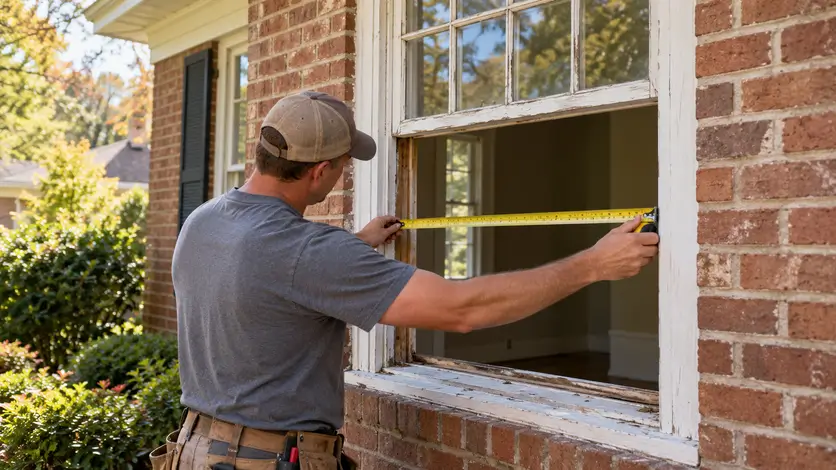
Count your windows yourself, opening by opening and room by room, before the first contractor walks through your house. This article explains how window companies tally what they replace, which shapes cause disagreements on paper, and how to turn your count into a list you can hold quotes against. It is written for homeowners around Fayetteville, GA who are about to ask for replacement prices.
Key Takeaways
- Bring your own written window list to every visit, so each company prices the same set of windows instead of its own tally.
- Ask every company whether its quote counts factory units or wall openings before you compare a single total.
- Note how many sections make up each bay or bow, since a quote may show it as one line or as several.
Why does the window count matter when you ask for quotes?
The count is the job description every contractor prices from, so your own list makes every quote cover the same windows. Ask for window replacement without one and each company makes its own tally during the visit; one missed basement window changes the total. Your list also lets you check a quote line by line. Sizes are a separate step, covered in measuring a window for replacement. With your count done, set it beside window replacement costs in Fayetteville before you request estimates for window replacement in Fayetteville.
Do window companies count by the unit or by the opening?
Both methods are in use, so ask each company which one its quote follows. A unit is one window as it leaves the factory, inside its own frame. An opening is one framed hole in your wall, which may hold a single unit or several joined together.
| Counting method | What counts as one | What to ask |
|---|---|---|
| By the unit | Each window with its own frame | How many units does the quote list? |
| By the opening | Each hole in the wall, whatever fills it | How many units sit in each opening? |
How are bays, bows, basement and other specialty windows counted?
A bay or bow fills one opening with several units joined together, so it can appear on a quote as one line or as each of its units. Ask which, and note how many sections you see. Basement windows go on your list as their own lines, including the small ones behind the water heater. If one needs to become an egress window, meaning one large enough to climb out of, note it: egress basement windows are counted and priced differently. List arched or round tops separately too.
What to write down for each window, room by room
Walk the house in one direction, room by room, and give every window its own line with a label you could find again (“kitchen, over the sink”). On each line, write down:
- Floor and wall: upstairs windows and those over a deck or slope are harder to reach, so mark where each one sits.
- How it opens: double-hung (both sashes slide), slider, casement (cranks outward) or fixed.
- Units in the opening: how many separate frames share that hole.
- Condition: fogged glass between panes, or soft, rotted wood at the sill.

How do you compare quotes when contractors count windows differently?
Compare each quote against your own list, not against the other quotes. Hand each contractor your room-by-room sheet, then ask them to write their line number or price beside every window on it, so a quote that counts a bay as one line and a quote that counts it as three both land on the same row. Then look for gaps: a window on your sheet with nothing beside it is missing from that quote. Divide a total by a window count only after every quote covers the same units.
How do the window count and window types affect the price?
The count sets how many units a quote has to price, and the type of each window sets what its own line costs, so two houses with the same count can get different totals. A casement that cranks outward is built differently from a fixed pane, while arched tops and bay units are made to their own shapes. Soft, rotted wood at a sill adds repair work to that window’s line. When a total looks high, the line prices show whether the count or the window types drove it.
Are twins, triples and picture windows with side lites one window or several?
That depends on how they were built. Each can be separate windows joined inside one opening or a single frame divided into panes, and a quote may list it either way. A twin is two windows side by side in one opening, and a triple is three. Contractors call these mulled units: separate windows fastened together along a vertical seam called a mullion. A picture window with side lites is a large fixed pane with a narrow window on each side (the side lites), which may open or stay fixed.
To tell what you have, look at the post between the glass. A wide post where two frames meet points to separate units joined together. A thin bar within one frame points to a single unit split into panes. Write “twin” or “triple” in that window’s label, and note whether each side lite opens, since an operating side lite is built differently from a fixed one.
If you would like help reading your list, contact Brightnest Transformations or call 678-835-9601 to talk it through.