Pick double hung windows where you open and clean the glass often, and single hung where a window mostly stays shut. Josh and Raymond Daniels, owners of Brightnest Transformations in Fayetteville, GA, wrote this article for homeowners replacing windows who want to decide one window at a time. It covers telling the two apart, living with each day to day, and why one costs more.
Key Takeaways
- The whole difference is one sash, the framed glass panel inside the frame: single hung moves one, double hung moves both.
- Try sliding the upper sash downward; if it moves you have double hung, and if it will not budge you have single hung.
- For a cross-breeze and glass you can wash from inside, two sliding sashes let hot air out high while cooler air enters low.
- Keep single hung for ground-floor windows you never open at the top and can wash from the yard; the fixed top sash adds weather resistance.
How to tell which type your windows are now
Push the upper sash down. If it slides, the window is double hung; if it stays put while only the bottom sash rises, it is single hung. Open the sash lock first, because a latched window feels fixed either way. These checks, all done from inside the room, confirm what you find:
| Check | Single hung | Double hung |
|---|---|---|
| Upper sash, pushed down | Does not move | Slides down in its track |
| Tilt latches on the upper sash | None | A pair, one at each top corner |
| Line where the upper sash meets the frame | Sealed, no gap to the frame | A visible seam where the sash can pull free |
Note the type of each window before you collect quotes. HomeAdvisor’s window replacement cost guide lists window type among the factors with the most influence on price, and our guide to window replacement cost in Fayetteville covers the full budget.
Ventilation, cleaning and everyday use
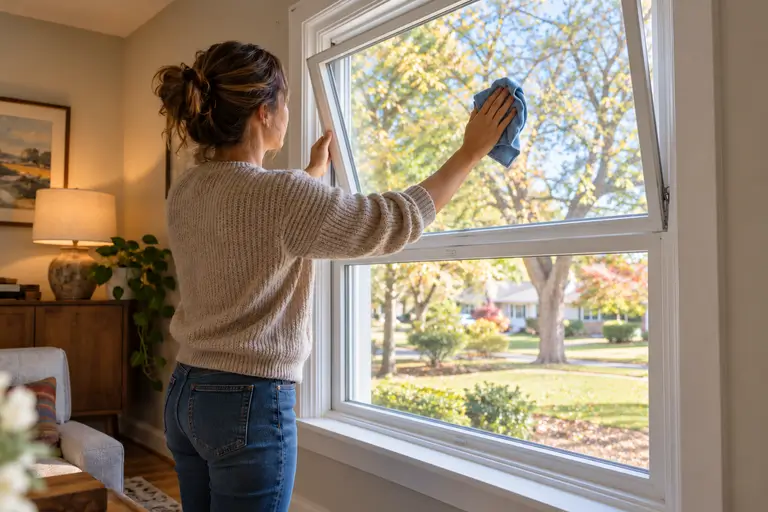
Double hung windows move more air and are easier to clean, because both sashes slide. Lower the top sash slightly while the bottom one is raised: warm air escapes near the ceiling as cooler air comes in low. A single hung window opens only through its lower half. For cleaning, a tilting upper sash lets you wash its outside glass from indoors. A fixed upper sash on a second story means a ladder. Ask whether the models you are quoted tilt in for cleaning.
When is a single hung window all you need, and where does it fall short?
A single hung window is all you need on a ground-floor opening you never want to open from the top and can wash from outside while standing on the ground. In that spot the fixed upper sash works in your favor: Simonton Windows says the stationary top sash improves weather resistance and efficiency. The same maker notes that single hung units open flush with the wall, so they stay clear of a patio or walkway outside.
It falls short where the top half is the half you want open. On a street-facing bedroom, lowering the upper sash brings in air while the lower sash stays shut. The same goes for a window above a yard where kids play. A single hung window cannot do that, because its only opening is down low. On a double hung, the sash lock cannot engage while the top sash is lowered, so fit vent stops or window opening control devices if the lower sash must stay secured. If your window replacement covers several rooms, run each window through this test before you settle on one style for the whole house.
Which window style suits each room of your home?
Choose by how each window gets used, since one house can carry both styles. A window over the kitchen sink is a good case for single hung: you reach it across a counter, and a top sash pulled down from there rarely gets touched. A window behind a bed or dresser works the same way. HomeAdvisor’s window replacement cost guide calls single hung the most popular style, at $100 to $400 each, so using it where it fits leaves more of the budget for double hung in the rooms you open most.
Mixing styles need not show from the street. Keep the frame color and grille pattern the same across both types, and the front of the house reads as one set. Frame material carries through every room too; our comparison of vinyl and fiberglass windows weighs the two. Write each opening’s style beside its size, using our steps on how to measure a window for replacement, then bring that list to your window replacement quote so every opening is priced as the type it needs.
Making the call when you replace your windows
Settle it on the windows you open. Think back over the last warm season: an opening that stayed shut through it gains little from a sliding top sash, while one you opened most days is where double hung earns its place. Then ask each installer to price every opening in both styles on the same quote, so the trade-off shows up line by line in dollars instead of as a guess. If two quotes recommend different styles for the same window, ask each installer why.
Which style costs more, and what drives the difference
The extra cost of a double hung window comes from its second working sash. That upper sash needs its own balances to hold it at any height, a pair of tilt latches and weatherstripping where it meets the frame. A single hung unit’s fixed top needs none of that. How wide the gap runs depends on the product line and the window’s size. On a quote, check that both styles come from the same line with the same glass, so the difference you see is the sash alone.
The difference: one moving sash or two
Both styles have two sashes, stacked one above the other. On a single hung window only the lower sash slides, and the upper one stays fixed in place. On a double hung window both sashes slide up and down in their own tracks. The frame material and the glass can be identical between the two, so two windows that look the same from the curb can work differently from inside the room.
Brightnest Transformations, owned by Josh and Raymond Daniels, is based in Fayetteville and serves Fayetteville, Jonesboro, Newnan, Peachtree City, McDonough, Stockbridge and Reynoldstown. To talk through which of your windows need that second moving sash, get in touch with us or call 678-835-9601.
Sources
- How Much Does Window Replacement Cost in 2026?, homeadvisor.com, retrieved 2026-10-13.
- Single Hung Windows Replacement – Vinyl Single Hung | Simonton, Simonton Windows, retrieved 2026-10-13.